
In addition to institutional teaching activities in different courses of study – Veterinary Medicine (single cycle – Department of Veterinary Sciences), Sustainability of Animal Production Systems (Master – Department of Veterinary Sciences) and Human Nutritional Sciences (Master – Department of Pharmacy) during the last years I took part in the following teaching projects:

Blended Intensive Programme (BIP) “Insects as Feed and Food”
3 ECTS
University of Pisa edition (2025) – Coordinator
| Blended Intensive Programme – Online part on 03 July 2025 – Presence part from 07 to 11 July 2025 Partners: – Česká zemědělská univerzita v Praze (Czech University of Life Sciences Prague, ČZU) – Prague, Czech Republic – Wageningen University & Research (WUR) – Wageningen, Netherlands – Stiftung Tierärztliche Hochschule Hannover (University of Veterinary Medicine Hannover-TiHo) – Hannover, Germany – Szkoła Główna Gospodarstwa Wiejskiego (Warsaw University of Life Sciences, SGGW), Warsaw, Poland |
| During the BIP, students had the possibility to get in touch with international lecturers and students. During the course, information relating to the edible insect sector was furnished, with main focuses on the environmental/social, economic, and production impacts, the legislative structure, and the nutritional value of insects and their characteristics, with a view to a progressive increase in animal production with a decrease in negative environmental impact. During the BIP, students visited the Department of Veterinary Sciences of the University of Pisa and had the possibility to visit an insect farm located in the north of Italy and joined a cooking class at ALMA – The School of Italian Culinary Arts – using insects as ingredients in some Italian recipes. |

Blended Intensive Programme (BIP) “Insects as Food: From Farm to Fork”
3 ECTS
Czech University of Life Sciences Prague edition (2024) – Partner
| Blended Intensive Programme – Online part on 04 September 2024 – Presence part from 09 to 13 September 2024 Partners: – University of Pisa (UNIPI) – Pisa, Italy – Wageningen University & Research (WUR) – Wageningen, Netherlands – Stiftung Tierärztliche Hochschule Hannover (University of Veterinary Medicine Hannover-TiHo) – Hannover, Germany – Szkoła Główna Gospodarstwa Wiejskiego (Warsaw University of Life Sciences, SGGW), Warsaw, Poland |
| During the BIP, students had the possibility to get in touch with international lecturers and students. During the course, key topics related to insect-based production were addressed, including insect farming practices, processing techniques, sensory analysis, and non-food applications of insects. Particular attention was given to the evaluation of insects as a sustainable resource, considering their nutritional properties and potential uses. As part of the workshop activities, students developed a project focused on creating an insect-based product (cookies), analysing its protein and lipid content, and assessing its sensory characteristics. Furthermore, the program included a one-day excursion, during which students visited a private zoo and an insect farm, gaining practical insight into insect rearing and management. See more here: Title: Teaching about edible insects: design and insights from the summer school “Insects as food: From farm to fork” Journal of Insects as Food and Feed, DOI: https://doi.org/10.1163/23524588-bja10319 |

Blended Intensive Programme (BIP) “Insects in Food”
3 ECTS
Ghent University edition (2023) – Partner
| Blended Intensive Programme – Online part from 05 to 08 June 2023 – Presence part from 04 to 08 September 2023 Partners: – University of Pisa (UNIPI) – Pisa, Italy – Česká zemědělská univerzita v Praze (Czech University of Life Sciences Prague, ČZU) – Prague, Czech Republic – Wageningen University & Research (WUR) – Wageningen, Netherlands – Swedish University of Agricultural Sciences (SLU) – Uppsala, Sweden |
| During the BIP, students had the possibility to get in touch with international lecturers and students. During the course, fundamental aspects of the use of insects as food were explored, with a focus on their nutritional value, including minor nutrients and antinutritional factors. The program also addressed the incorporation of insects as ingredients, as well as the design and structural properties of insect-based food products, considering their environmental and societal impacts. As part of the practical activities, participants developed insect-based food products such as chocolate, bakery items, margarine, and whipped cream substitutes, applying the theoretical knowledge acquired. Additionally, the program included a visit to an insect-processing facility, providing participants with direct insight into industrial practices and production processes. |
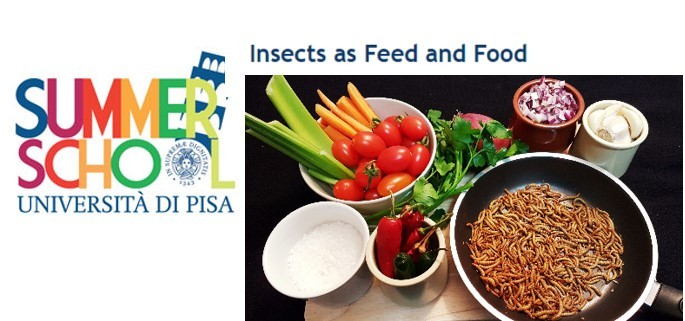
Summer School “Insects as Feed and Food”
3 ECTS
University of Pisa – Coordinator
| Online Summer School (COVID-19 restrictions) from 12 to 15 July 2021 Lectures from: University of Pisa (Pisa, Italy), Istituto Zooprofilattico Sperimentale delle Venezie (Venice, Italy), Istituto Zooprofilattico Sperimentale del Lazio e della Toscana (Viterbo, Italy), University of Turin (Turin, Italy), KU Leuven Campus Geel (Geel, Belgium), Inagro (Rumbeke-Beitem, Belgium), University of Padua (Padua, Italy), University of Florence (Florence, Italy), Ghent University (Gent, Belgium), University of Parma (Parma, Italy) |
| During the course, participants were introduced to the insect sector through an overview of its relevance and potential, including the reasons for using insects as food and feed. Key aspects such as European legislation for both feed and food, as well as microbiological and safety considerations, were addressed to provide a comprehensive regulatory and scientific framework. The program also covered the practical setup of insect-rearing facilities, with a focus on species such as black soldier fly, mealworms, and crickets. The use of insects as feed for poultry and fish, along with their application as food—considering nutritional value and processing techniques—was explored. In addition, attention was given to consumer acceptance and perceptions of insects as food and feed, as well as to the current state and future prospects of the insect sector. Throughout the course, daily wrap-up sessions with Q&A supported knowledge consolidation. Participants were also engaged in group assignments, working in teams to discuss and deepen the topics covered. The course concluded with a final multiple-choice test to assess the knowledge acquired. |