
Our research addresses the stereochemistry of chiral molecules and materials, combining chiroptical spectroscopies (ECD, VCD, CPL) with quantum-chemical calculations to determine configuration, conformation and aggregation modes.

Chiral materials
Conjugated organic polymers — PPVs, PPEs and polythiophenes — are “materials with unique properties, not otherwise observable” (Alan Heeger, 2000 Nobel in Chemistry), used in photovoltaics, OLEDs, sensors and field-effect transistors. Chirality in π-conjugated materials adds a further dimension, opening the way to circularly-polarized OLEDs, quantum optics, anticounterfeiting and spintronics.
Electronic CD (ECD) and circularly polarized luminescence (CPL) are ideal techniques for characterizing thin films of these materials and their multiple aggregation pathways. The CD@Pisa group has developed several π-conjugated compounds with exceptional chiroptical properties, including giant ECD signals and non-reciprocal ECD and CPL spectra, which invert sign upon sample flipping. We use synchrotron light (Diamond, UK) for ECD and Mueller-matrix mapping of polymer thin films at sub-mm resolution.
People involved: Lorenzo Di Bari, Francesco Zinna, Gianluigi Albano (Parma), Diamond B23 beam scientists, Marcin Górecki (PAS).
Selected publications:
- Chiroptical Properties in Thin Films of π-Conjugated Systems — Chem. Rev. 2020
- Transforming Achiral Semiconductors into Chiral Domains with Exceptional Circular Dichroism — Science 2025
- A 2D Chiral Microcavity Based on Apparent Circular Dichroism — Nat. Commun. 2024
- Emergent Nonreciprocal Circularly Polarized Emission from an Organic Thin Film — Adv. Mater. 2020
- Spatially Resolved Chiroptical Spectroscopies of Thin Films of Chiral Organic Dyes — Chem. Eur. J. 2023
- Reciprocal and Non-reciprocal Chiroptical Features in Thin Films of Organic Dyes — ChemNanoMat 2022
- Spatially Resolved Chiroptical Study by SR-ECDi — Aggregate 2022
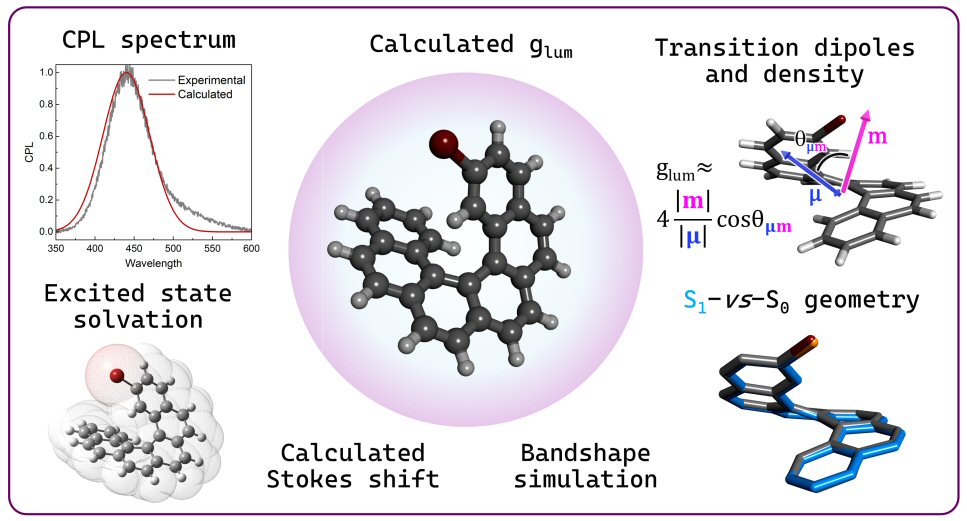
Interpretation and prediction of chiroptical properties
Few areas of fundamental chemistry have changed as dramatically in recent decades as the quantum-mechanical simulation of molecular properties. The calculation of ECD, VCD and CPL spectra is a particularly significant example. Our work in this field spans several systems and properties, and concerns the prediction and rationalization of:
- ECD and CPL properties of synthetic organic molecules, especially the helicenoids developed by Jérôme Lacour’s group
- ECD and MCD of finite aggregates of organic compounds, to disentangle aggregation modes
- ECD of transition-metal and lanthanide complexes
People involved: Francesco Zinna, Jérôme Lacour (Univ. Genève), Ciro A. Guido (Università del Piemonte Orientale).
Selected publications:
- Quantum Chemistry Calculations of Circularly Polarized Luminescence (CPL): From Spectral Modeling to Molecular Design (C. A. Guido, F. Zinna, G. Pescitelli) — Chem. Rev. 2025
- Magnetic Circular Dichroism Elucidates Molecular Interactions in Aggregated Chiral Organic Materials — Angew. Chem. Int. Ed. 2024
- Supramolecular Control of Helicene Circularly Polarized Luminescence Emitters in Molecular Solids and Bright Nanoparticles — Angew. Chem. Int. Ed. 2024
- Skeletal Rearrangement of [4]Helicenes under Acidic Conditions — Chem. Sci. 2026
- Multistate Aggregation-Induced Chiroptical Properties of Enantiopure Disulfide-Mediated Bispyrene Macrocycles — Angew. Chem. Int. Ed. 2023
- CPL Calculations of [7]Helicenes with Alleged Exceptional Emission Dissymmetry Values (C. A. Guido, F. Zinna, G. Pescitelli) — J. Mater. Chem. C 2023

Absolute configuration assignment of natural products
Most natural products, such as the secondary metabolites of fungi, are chiral and contain multiple stereogenic elements. While relatively few of them are crystalline, almost all contain at least one chromophore and provide measurable ECD spectra. Nowadays, the simulation of ECD spectra with TDDFT methods is a practical and reliable means for assigning absolute configurations.
Selected publications:
- Good Computational Practice in the Assignment of Absolute Configurations by TDDFT Calculations of ECD Spectra (G. Pescitelli, T. Bruhn) — Chirality 2016
- Absolute Configuration Determination by Quantum Mechanical Calculation of Chiroptical Spectra: Basics and Applications to Fungal Metabolites (S. Superchi, P. Scafato, M. Górecki, G. Pescitelli) — Curr. Med. Chem. 2018
- Absolute Structural Elucidation of Natural Products — a Focus on Quantum-Mechanical Calculations of Solid-State CD Spectra (G. Pescitelli, T. Kurtán, U. Flörke, K. Krohn) — Chirality 2009

Exceptional chiroptical activity of Co(II) complexes
Chiral cobalt(II) complexes with high-spin d7 configuration exhibit a continuous superspectrum of absorption and CD bands spanning the UV, vis, NIR and IR regions. Especially remarkable are VCD spectra featuring exceptional intensity due to the coupling between ligand vibrations and metal-centered low-lying electronic states. We designed and characterized several families of Co(II) complexes with record VCD dissymmetry g-factors up to 0.2. Such enhancement makes it possible to register a VCD spectrum with a single accumulation in seconds.
People involved: Fabio Marchetti, Massimo Guelfi, Christoph Janiak (Heinrich-Heine-Universität Düsseldorf), Mohammed Enamullah (Jahangirnagar University).
Selected publications:
- A Family of Cobalt(II) Complexes Exhibiting Record Dissymmetry Factors in Vibrational Circular Dichroism — Angew. Chem. Int. Ed. 2026
- The Phenomenon of Vibrational Circular Dichroism Enhancement: A Systematic Survey of Literature Data — J. Phys. Chem. B 2024
- Symmetry-Dependent Vibrational Circular Dichroism Enhancement in Co(II) Salicylaldiminato Complexes — J. Phys. Chem. Lett. 2019
- Broad-Range Spectral Analysis for Chiral Metal Coordination Compounds: (Chiro)optical Superspectrum of Cobalt(II) Complexes — Inorg. Chem. 2018