Description: The course aims to provide students with basic knowledge for understanding particle physics experiments. The engineering analysis needed for the correct execution of these experiments will be studied in detail, with particular reference to the activities of the Fermi National Accelerator Laboratory research center (Fermilab, Batavia, Illinois, USA), such as the design of mechanical systems, the definition of assembly procedures, design of vibration isolation systems, multi-physics analysis (structural, thermal, electromagnetic). The course consists of a first part of lectures and a second part in which students will be integrated into the working group of a research center in high energy physics and will personally follow the development of the project activity. While the course is coordinated by Unipi and FNAL, it is open for cooperation with other reserach centers in this phield.
Activities on similar topics were recently successfully carried out by Master Thesis students in Mechanical Engineering (e.g. Tommaso Aiazzi, Enrico Bargagna), who demonstrated to have the needed skills and background. Thus, the course can be propedeutic for the possible prosecution of the activity in a Master Thesis.

CFU: 6
Final exam: The student must prepare a final report and present the activity carried out and the results obtained to the examination commission with the aid of IT tools. The test will be assigned a mark on a scale of thirty.
Selection criteria: To ensure the successful involvement of students within the working group, a selection could be envisaged if the number of interested students is greater than the possibilities for integration in the research center and the number of projects available. In this case, the selection will take place on the basis of the candidates’ curriculum and the outcome of an interview.
How to apply
Students interested in the course should send their CV, along with the list of exams and marks (both for Bachelor’s and Master’s Degrees), to paolo.neri@unipi.it, indicating the projects they are preliminarily more interested in (see below). During the first class, the projects will be explained more in detail and, depending on the requests, the best match between candidates and activities will be proposed. All the proposed projects require mechanical design and numerical simulation skills, which correspond to the background of Mechanical Engineering students.
For any questions or doubts, contact paolo.neri@unipi.it
Proposed Projects: 2026-2027
All the projects are related to equipment for particle accelerators and were defined in collaboration with leading Global Research Centers in the field.
Coordinators:
Paolo Neri & Donato Passarelli

SRF Cavity Design through Machine Learning Approaches
Superconducting cavity design is a resource-intensive process involving multidisciplinary analyses and multi-parameter optimization, often requiring months of work by SRF and mechanical experts. This project explores a machine-learning-based framework to make the design process more efficient, less dependent on expert intervention, and applicable to a broader parameter space. Using an existing elliptical multi-cell cavity, AI models trained on electromagnetic simulation data will learn the relationship between cavity geometry and RF performance, enabling rapid prediction of key figures of merit and multi-objective optimization. The workflow will be benchmarked against the existing design and is expected to be scalable to additional parameters, inverse-design tasks, and more complex applications.
Supervisors: Ting Xu, Donato Passarelli – MSU, Fermilab
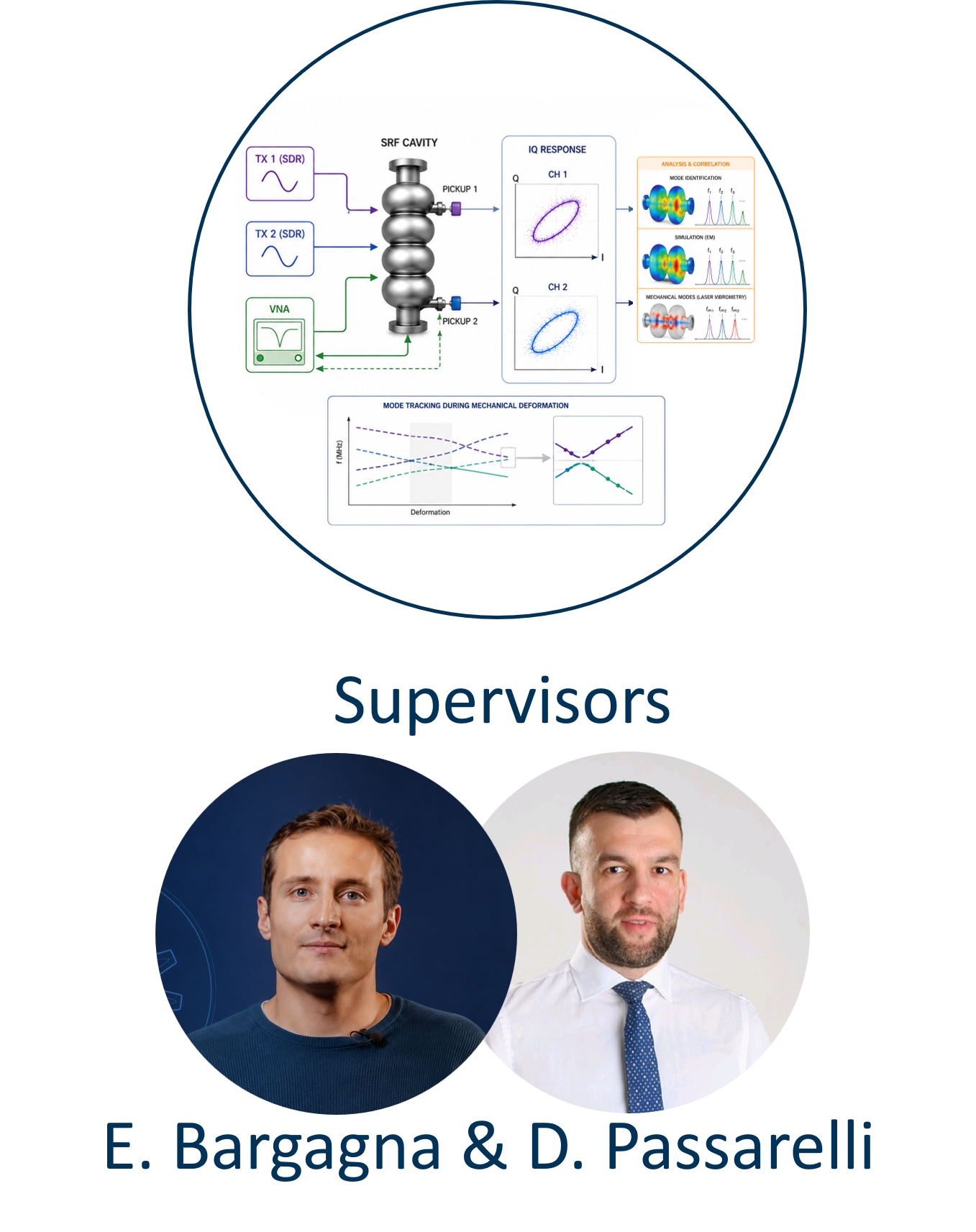
Selective Excitation of Electromagnetic Modes in SRF Cavities Using SDR
The project will develop a coherent multichannel measurement system based on VNA and Software Defined Radios to characterize electromagnetic modes in superconducting radio-frequency cavities. Complex RF responses acquired simultaneously from two pickup points will be used to define spatial mode signatures and track closely spaced modes during controlled mechanical deformation. The two transmission channels will also be used to investigate selective mode excitation through programmable amplitude and phase control, including in-phase and out-of-phase driving schemes. Experimental results will be compared with electromagnetic simulations and correlated with mechanical mode shapes. The final system will support the study of cavity deformation, electromagnetic mode evolution, and microphonics-induced frequency shifts.
Supervisors: Enrico Bargagna, Donato Passarelli – Unipi, Fermilab
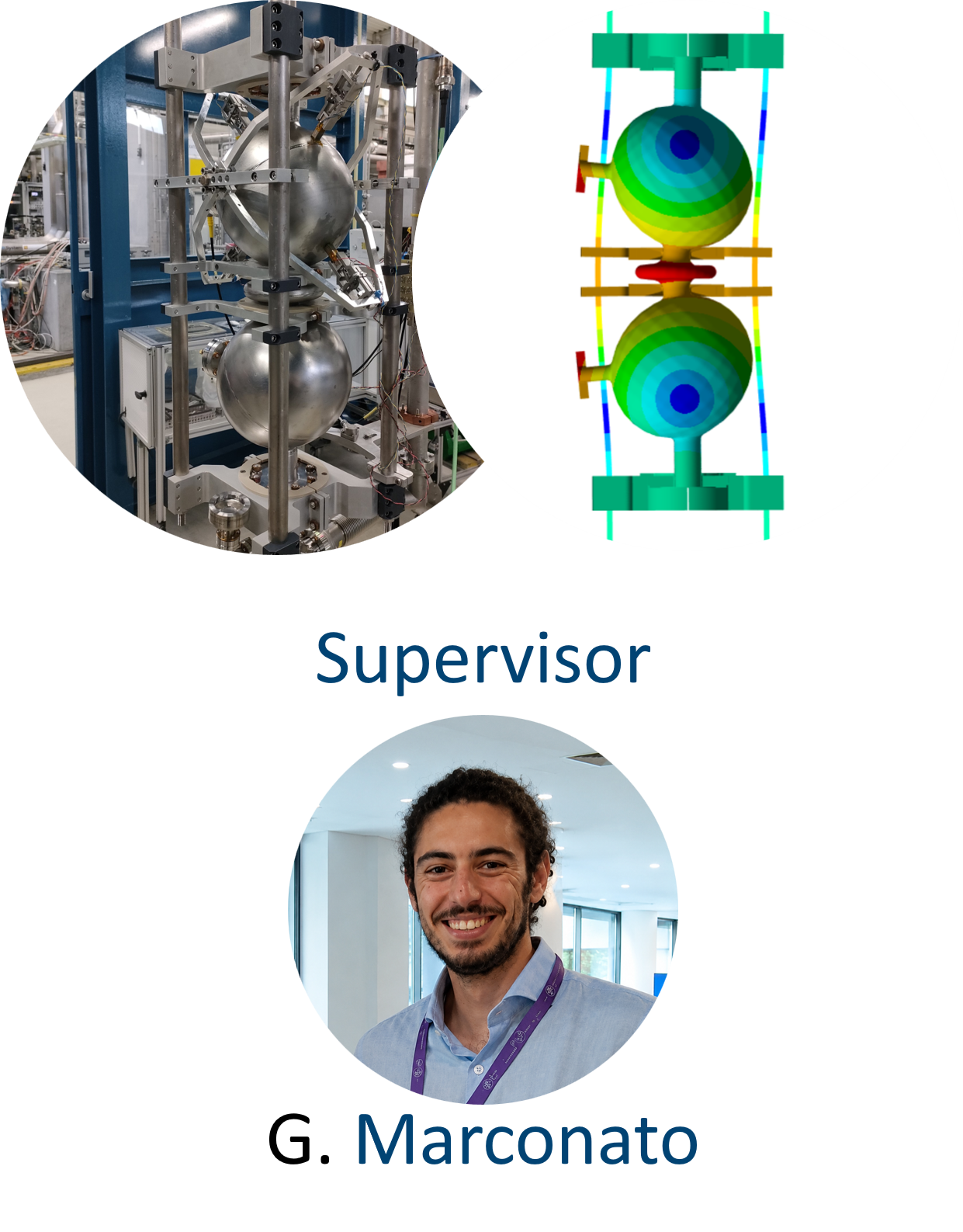
Numerical and Experimental Analysis of the MAGO Cavity
The project will focus on the refinement and validation of the finite-element model of the MAGO cavity and its supporting assembly using the available experimental vibration measurements. The student will perform modal and frequency-response analyses of the complete assembly and selected subassemblies, comparing the predicted natural frequencies and mode shapes with measurements obtained at room temperature and at 2 K, aiming at tuning and calibrating the numerical model. The expected outcome is a validated model able to reproduce the main mechanical resonances of the MAGO assembly and to support future design and experimental activities for the detection of Gravitational Waves.
Supervisor: Giovanni Marconato – University of Hamburg – DESY
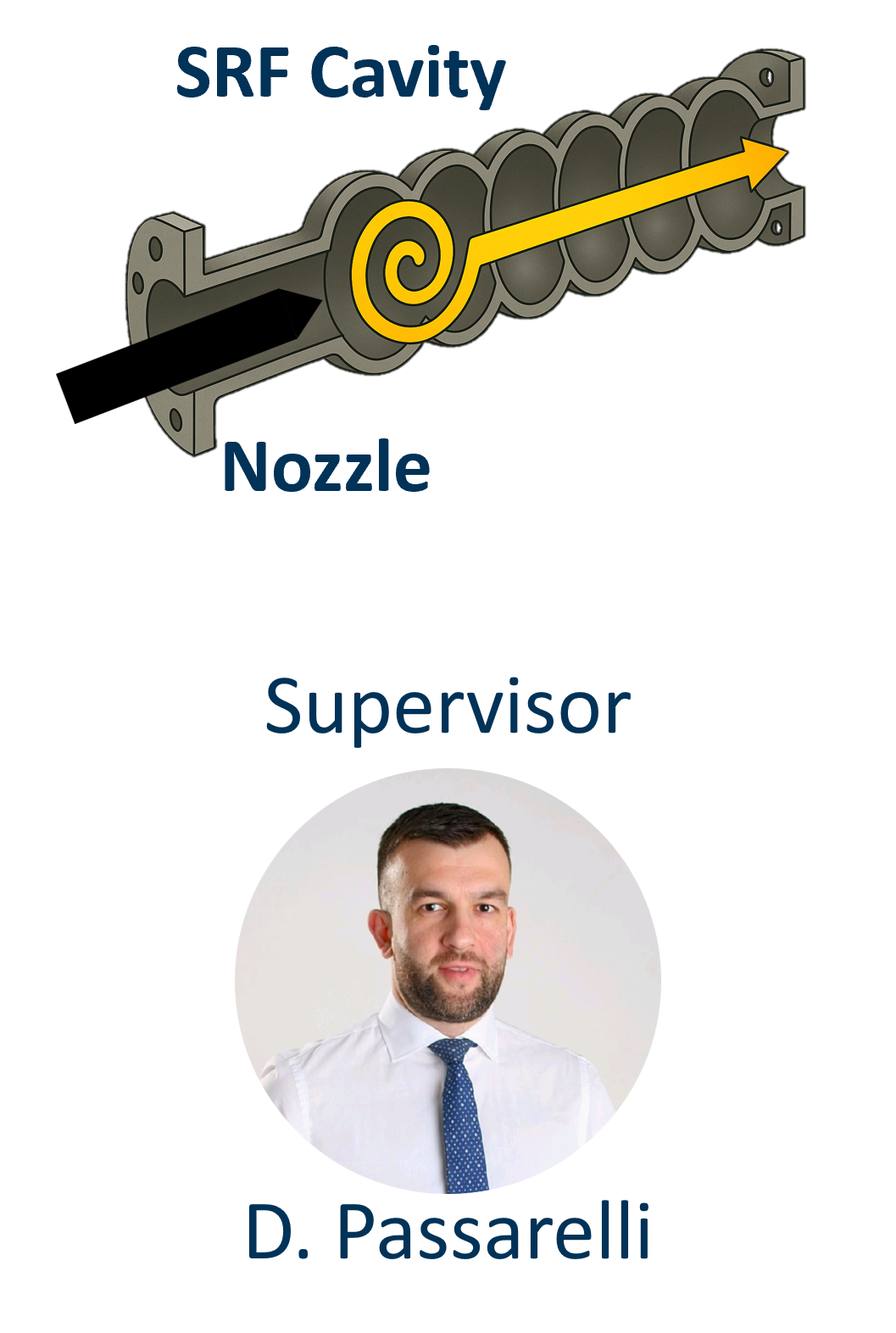
Feasibility Study of Dry Gas Jet Cleaning for SRF Cavities
The candidate will investigate the feasibility of using high-pressure nitrogen gas jets as a dry addition to the traditional high-pressure water rinsing (HPR) for cleaning superconducting radio-frequency (SRF) cavities. The goal is to develop a dry particle-removal technique that can be integrated into cleanroom to mitigate field emissions. The project will focus on fluid dynamics analysis to characterize the internal flow behavior of high-velocity nitrogen within 1-cell and multi-cell elliptical cavities. Computational modeling will explore nozzle geometries, flow parameters (pressure, velocity, angle), and effectiveness.
Supervisor: Donato Passarelli – Fermilab
Past Projects


