
Multichromophoric systems and excitons
Supramolecular and molecular systems composed of many chromophores are ubiquitous in biochemistry and material science. Delocalized excitations (excitons) shape the optical and chiroptical properties of these “multichromophoric” systems. Furthermore, new photophysical pathways arise, such as excitation energy transfer (EET), charge transfer, dynamic localization, etc.
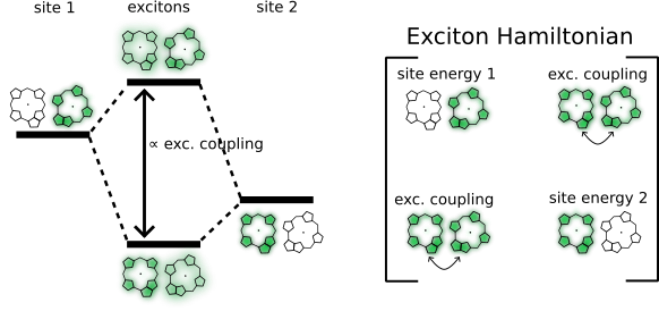
We develop new methods to describe the spectroscopy and photophysics of multichromophoric systems from first principles. We combine multiscale quantum chemistry, vibronic coupling models, and quantum dynamics in open-system and closed-system formulation to give a complete description of the dynamic properties of such systems.
We collaborate with the groups of Carles Curutchet (Universitat de Barcelona, Spain), Thomas Renger (JKU Universitat Linz, Austria), and Fabrizio Santoro (CNR, Pisa, Italy)
Selected publications
Quantum Chemical Modeling of the Photoinduced Activity of Multichromophoric Biosystems.
Segatta, F., Cupellini, L., Garavelli, M., Mennucci, B.
Chem. Rev. 2019, 119 , 9361-9380 DOI: 10.1021/acs.chemrev.9b00135
Quantum Dynamics Simulations Reveal Ultrafast and Coherent Charge Transfer in the Lhca4 Antenna of Photosystem I
Saraceno, P., Santoro, F., Cupellini, L.
J. Phys. Chem. Lett. 2025, DOI: 10.1021/acs.jpclett.5c02463
Light harvesting and photoprotection in photosynthesis
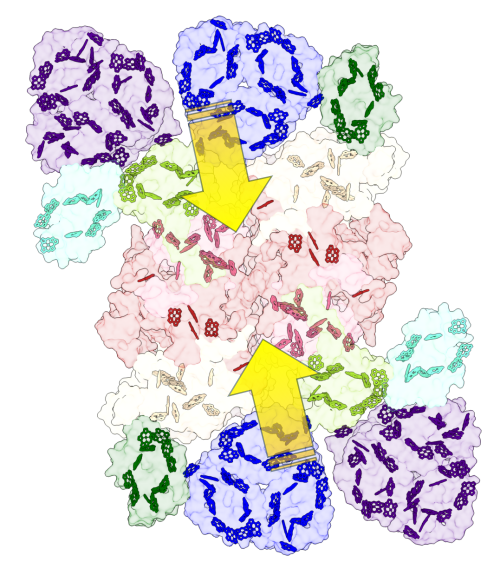
Light harvesting is a crucial step of photosynthesis, whereby photosynthetic pigments contained in antenna complexes absorb sunlight and transport the excitation energy towards the reaction centers, where chage separation occurs. When too much light is absorbed, photosynthetic organisms activate photoprotection strategies, such as nonphotochemical quenching, which help regulate energy transport and dissipate excess energy. The energy flow within and between complexes depends on the properties of the multichromophoric aggregate: pigment-pigment excitonic interactions, pigment-protein interactions, and vibronic coupling. Ultrafast nonlinear spectroscopy can probe the exciton dynamics in the femtosecond to picosecond time scales, but first-principles models can achieve an atomistic understanding of such processes.

We employ molecular modelling and molecular dynamics techniques, multiscale quantum chemistry, spectroscopy simulations, and open quantum systems dynamics methods to unravel key properties of antenna complexes and photosystems. We devise computational strategies to understand how the structure shapes the properties and dynamics of photosynthetic pigment aggregates, from small light-harvesting complexes to entire photosystems.
Main collaborations
- Giulio Cerullo (Politecnico di Milano)
- Roberta Croce (Vrije Universitet Amsterdam)
- Nicoletta Liguori (ICFO, Barcelona)
- Tjaart P. J. Krüger (University of Pretoria)
- Tomáš Polívka and David Bína (University of South Bohemia)
Selected publications
Energetic Landscape and Terminal Emitters of Phycobilisome Cores from Quantum Chemical Modeling
Cupellini, L., Gwizdala, M., Tjaart P. J. Krüger, T. P. J.
J. Phys. Chem. Lett. 2024, 15, 38, 9746–9756
The atomistic modeling of light-harvesting complexes from the physical models to the computational protocol
Cignoni, E., Slama, V., Cupellini, L., Mennucci, B.
J. Chem. Phys. 156, 120901 (2022)
Multiscale methods and machine learning

Multiscale methods are key to describe chemical and photochemical processes in condensed phase, whether in solution or in more complex biological matrices. We develop and apply polarizable embedding methods to describe ground and excited states of systems in complex environments and their dynamics. The QM/MMPol method, a QM/MM scheme based on induced point dipoles, gives an exquisite description of environment effects on excited states. We further develop methods to include density-dependent nonelectrostatic interactions (e.g. dispersion) in QM/MM.

The computational bottleneck of QM methods can be overcome by machine learning (ML) potentials. With ML potentials it is possible to simulate QM-level molecular dynamics with strongly reduced computational effort. However, ML methods alone cannot be coupled with MM in the same way as QM methods. We develop physics-based electrostatic embedding ML/MM models designed to reproduce the physics of QM/MM schemes. These models can predict how ground-state and excited-dynamics change with changing environment.
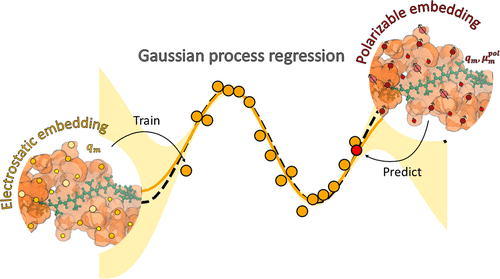
We also develop ML/MM models that target excitation energies in solvent and protein environments, and disentangle the multiple effects of a polarizable environment on the solvatochromic shifts.
Main collaborations
- Benedetta Mennucci (UNIPI)
- Filippo Lipparini (UNIPI)