
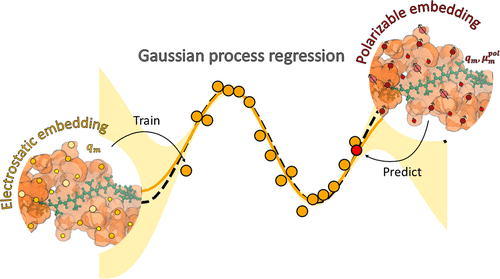
We developed a machine-learning (ML) framework capable of predicting the different environmental contributions to excitation energies of chromophores in a polarizable embedding. Polarizable embedding is one of the most advanced QM/MM schemes to describe electronic excitations, but it inherits the computational cost of the QM calculation. While machine learning QM/MM schemes exist, they are limited to the simpler electrostatic embedding framework. We developed hierarchical models to capture both the effect of ground-state polarization and the response of the polarizable environment to the electronic transition. Our models can be trained on non-polarizable QM/MM calculations and reproduce the effect of a polarizable environment. We tested our method on chlorophyll and carotenoid molecules present in light-harvesting complexes.
C. John, E. Cignoni, L. Cupellini, B. Mennucci.
Machine-Learning Framework for Excitation Energies of Chromophores in Polarizable Environments
J Chem Inf Model (2026) ASAP; DOI 10.1021/acs.jcim.5c02424