
Xantophylls are oxygenated derivatives of carotenes, which play essential roles in photosynthetic light harvesting and photoprotection. Their unique and tunable photophysical properties arise from their complex electronic-state manifold, but the accurate description of their excited states at a feasible computational cost remains challenging.
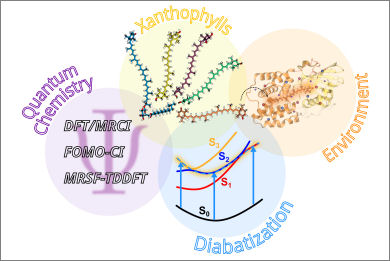
In this work published on JCTC, we compared three cost-effective methods, DFT/MRCI, FOMO–CI, and MRSF-TDDFT, in the descriptions of the excited states for a representative set of xantophylls. To overcome the complexity of the excited-state manifold and consistently characterize electronic states across methods, we proposed a multiple-property-based diabatization (MPD) strategy. We sought to provide a strategy for understanding xanthophyll photophysics with cost-effective methods.
We found out, somewhat surprisingly, that these methods provide a very similar picture of the excited state manifold along the excited-state relaxation coordinates, although the MRSF results are strongly dependent on the functional. Overall, our work supports the use of cost-effective methods to describe the excited-state dynamics of xanthophylls.
Arcidiacono, A., Martini, V., Cupellini, L. & Pedraza-González, L.
Modeling Xanthophyll Excited States via Cost-Effective Quantum Chemistry methods and Property-Based Diabatization
J. Chem. Theory Comput. (2026) https://pubs.acs.org/doi/10.1021/acs.jctc.6c00637