
Topic I: CEFR coordinated research project
The proposed Thesis work is in the framework of the IAEA Coordinated Research Project (CRP): “Neutronics Benchmark of CEFR Start-Up Tests”.
The Coordinated Research Project (CRP) will focus on neutronics benchmark analysis of the physics start-up tests performed at the China Experimental Fast Reactor (CEFR) in 2010-2011.
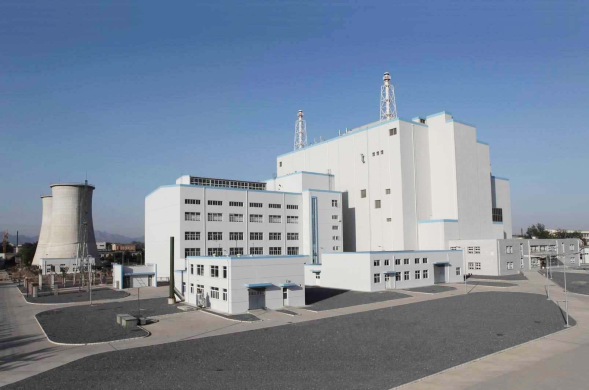
CEFR is a small-size sodium-cooled fast reactor with a high neutron leakage core fuelled with uranium oxide and stainless-steel radial reflector.
Benchmark analysis of CEFR physics start-up tests will include evaluation of the criticality, control rod worth, reactivity effects, and neutron spectral characteristics. The recorded experimental data from the CEFR start-up will provide an excellent opportunity to validate the physical models and neutronic simulation codes.
The activities of the CRP have been performed in collaboration between NINE and UNIPI. A benchmark extension has been proposed including the following aspects:
• Burn-up
• Deep penetration
• Neutron dynamics
• Neutron Spectrum
• Group Constants
• Kinetic Parameters
• Reactivity distribution
Possible thesis activities
The activities to be performed will be related to the benchmark participation. In particular, the input developed in the Serpent 2 code will be provided. It has to be adapted to the analysis of the new work packages. Results will be compared with other participants and experimental data (when available).
Topic II: Rostov-2 VVER-1000 benchmark
The Rostov-2 VVER-1000 benchmark tests the capabilities of 3D multi-physics reactor simulation codes to analyze complex transients with coupled core-plant interactions and complicated fluid mixing phenomena. The benchmark aims to compare the performance of traditional multi-physics codes and novel high-fidelity multi-physics code systems and methods and to provide recommendations on the advantages and disadvantages of standard and novel approaches.

Several tests with well-documented neutronics and thermal-hydraulics measurement data have been performed at the Rostov Unit 2 (Rostov-2) nuclear power plant (NPP). The benchmark team selected a test (transient), which allows validation of novel high-fidelity multi-physics codes. Differently from all previous multi-physics OECD/NEA benchmarks for coupled code validation, implementing high-fidelity multi-physics simulation codes could allow predicting pin-by-pin power distributions and flow mixing in the reactor pressure vessel including its active core part.
The Rostov-2 VVER-1000 benchmark has two phases with a suite of sequential exercises. The first phase is designed to provide the framework to assess the ability of the standard multi-physics (coupled system thermal-hydraulic (TH)/neutronics (N)) codes to predict the transient response of the power plant at an assembly-wise level. Thus, an assembly-wise homogenization of thermal-hydraulics and neutron physics parameters will be applied. The second phase of the benchmark is still under development.
Possible thesis activities
Based on previous works that concerned the development of a cross-section database and a preliminary PARCS model of the Rostov-2 core, the current activities will include participation at the benchmark with the Phase I Exercise 2 – Coupled 3-D neutronics/core thermal-hydraulic response evaluation. The purpose of this exercise is to model the reactor pressure vessel with the active core only. Inlet and outlet core transient boundary conditions are provided by the benchmark team, based on calculations performed with coupled system code or applying any information directly from the measured data. Simulation of the hot zero power (HZP) state of the reactor core (Exercise I-2a) is part of this exercise to test the neutronics model including the cross-section library. Exercise I-2b includes calculations of initial hot power (HP) steady-state conditions and the transient test scenario simulation. The required two-group assembly-wise homogenized cross-section library is provided in electronic format. In case of interest, the participants can generate their own two-group assembly-wise homogenized cross-section library.
In particular:
- The PARCS model has to be verified
- The RELAP model of the pressure vessel has to be developed and coupled with the PARCS model
- Analysis of the exercise has to be performed.
Topic III: Novel methodology for Doppler treatment
The traditional tools used for reactor physics analysis often rely on diffusion theory. These calculations typically follow a three-step approach. (Figure 0-1). In the lattice calculation phase, nuclear data undergo spatial homogenization and energy collapse to facilitate their utilization in a nodal code.
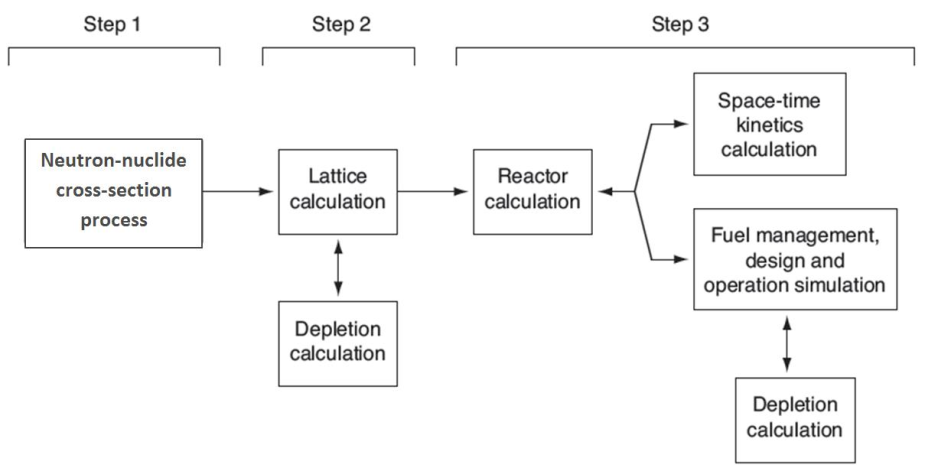
These homogenized data are then parameterized to accommodate various thermal-hydraulic conditions and reactor states, such as fuel temperature, moderator temperature and density, soluble poison concentration, and control rod insertion. An important consideration lies in the treatment of fuel temperature, as it significantly influences absorption resonances within the fuel pin. In particular, as the temperature increases, the absorption resonances in the nuclear fuel broaden, a phenomenon commonly referred to as the Doppler effect. Given the significance of this topic, the Organization for Economic Cooperation and Development (OECD)/Nuclear Energy Agency (NEA) initiated a dedicated Task Force in 2022 called the Task Force on Fuel Temperature Assumptions in Depletion Analyses. The primary objective of this Task Force is to evaluate the bias and uncertainties associated with existing correlations, assess the impact of various Doppler feedback approaches in safety analyses, and propose novel approaches that go beyond that of effective temperatures.
Proposed New Methodology
The main objective of the NINE proposed approach is to explore the definition of fuel temperature used for the Doppler effect on specific figures of merit during transient accident analysis.
The major difference from the methodology outlined in the previous section is the consideration of a fuel temperature distribution within the fuel pin, achieved by defining a suitable mesh inside the fuel pellet, as shown in Figure 2.
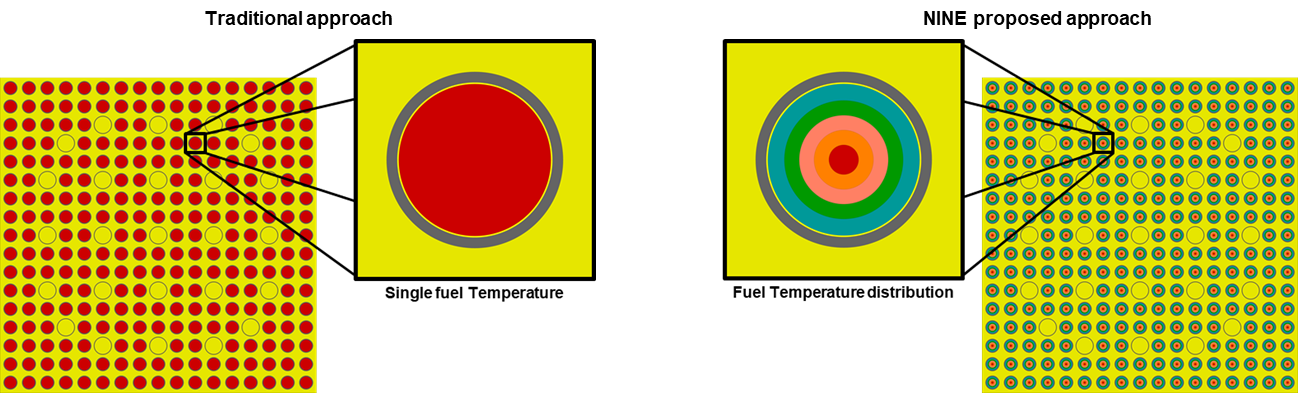
The knowledge of fuel temperature distribution allows enhancing the treatment of pellet self-shielding. This involves considering, in the homogenized data, the influence of the fuel temperature’s shape inside the pellet, and how it affects resonance broadening in the different pellet regions. The temperature distribution is considered both in the homogenization procedure and the nodal code. The database is produced by varying the temperature of each radial layer. In this way, different temperature shapes are achieved. Considering 5 different radial layers a pellet subdivision like that shown in Figure 2 (left) is obtained. The homogenized data libraries obtained using this methodology will be parameterized similarly to the traditional approach, except for fuel temperature. It will depend on all the fuel temperature values of each considered layer, as illustrated in the following equation, where N represents the number of concentric layers.
Σhom=Σ(history, CR, Tf1, Tf2, …, TfN, Tm, …)
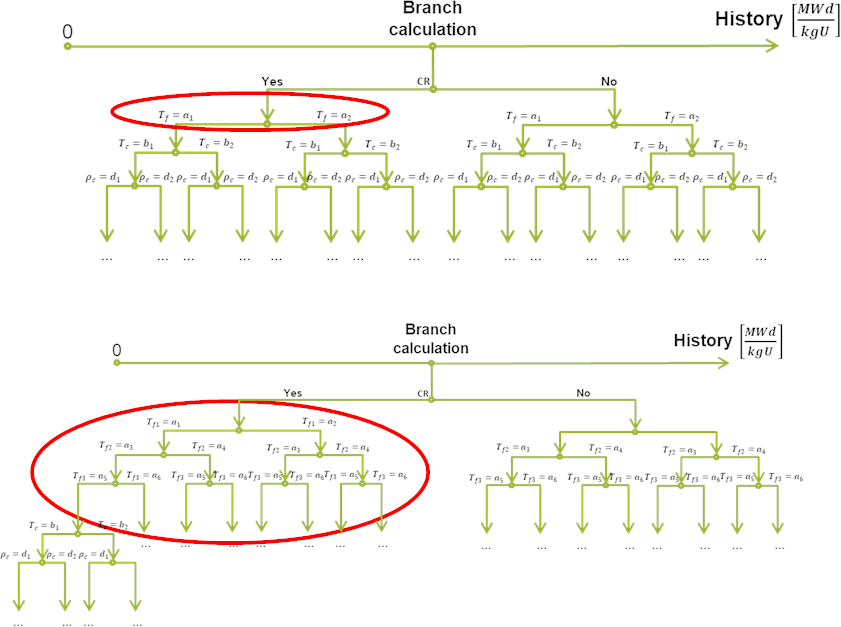
In the homogenization process, the steps performed remain the same as in the traditional methodology. The only difference lies in the number of instantaneous variables considered. Previously, only one fuel temperature was considered, whereas now one for each layer is accounted for, as illustrated in Figure 3. Consequently, more branches are generated, resulting in a much bigger database.
The final step will involve implementing the interpolation of the homogenized data, considering a larger number of state variables, in the nodal diffusion code. This process will require modifying the subroutine of the code responsible for reading the database and interpolating the data to obtain the corresponding value for the provided state from the thermal-hydraulic/fuel performance code.
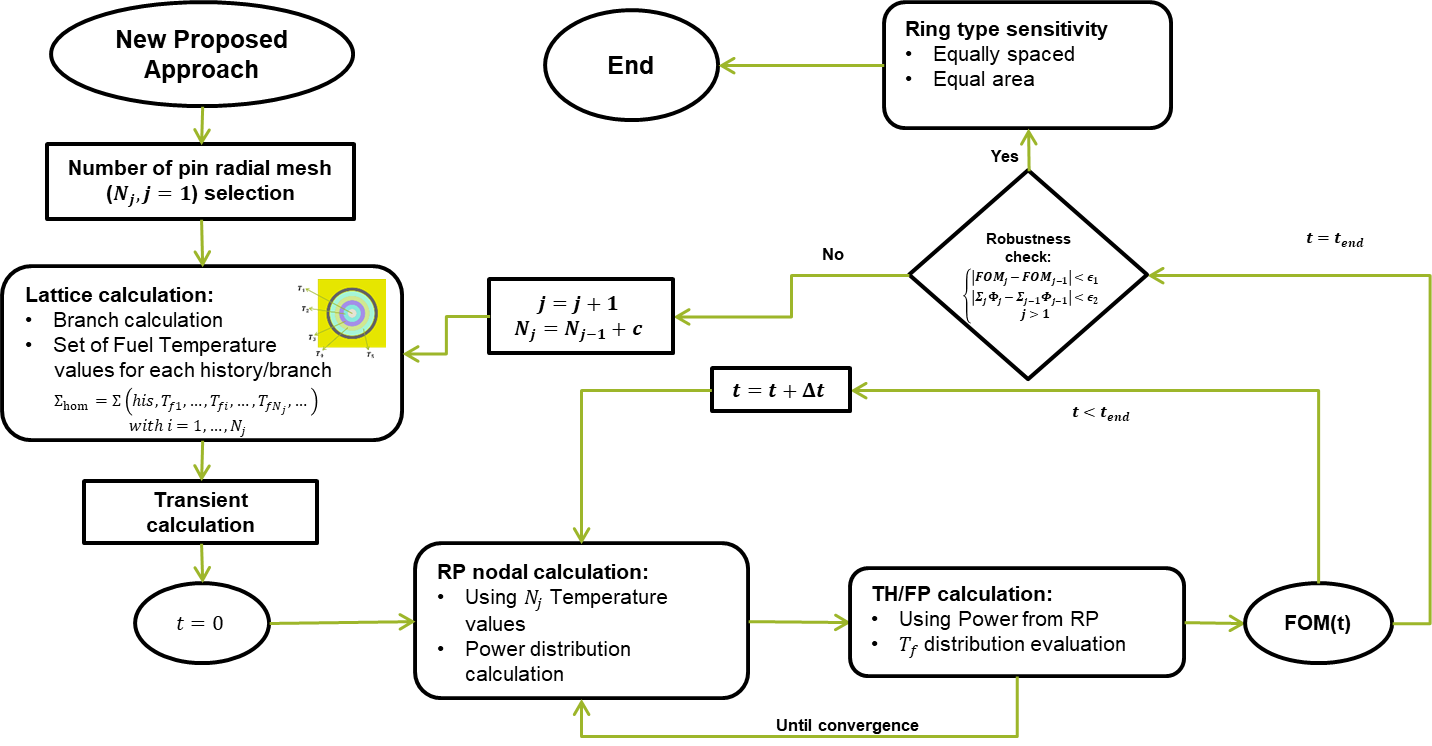
An essential aspect of the methodology is the selection of a sufficient number of radial mesh points. A process has been developed to determine the optimal number of radial mesh points, as shown by the diagram in Figure 4. The process begins with a tentative number of radial mesh points, denoted as N. A lattice calculation is conducted, producing homogenized data. Subsequently, a transient calculation is performed until reaching the end time. Then, a second tentative value larger than the first one is used, and the entire process is repeated. A comparison is made, considering both selected figures of merit and relevant reaction rates. If the difference between the two cases exceeds a defined threshold, the number of radial mesh points is increased, and the analysis is repeated. Once convergence is achieved between the previous and current number of radial mesh points, a sensitivity analysis in ring type can be conducted to assess if the ring definition influences the final result.
Possible thesis activities
- Implementation of the methodology in a diffusion code and comparison tests with Monte Carlo finite lattice calculation.
- Cross-section generation with:
- Relevant temperature distribution identification;
- Application of iterative procedure to the cross-section to find no relevant dependencies on the number of radial rings considered;
- Study on the ring shape distribution;
- Production of a complete set of cross-sections for full core transient analysis, once the methodology is implemented in the diffusion code.